
#P13966. [VKOSHP 2024] Intermediate Verticality

[VKOSHP 2024] Intermediate Verticality
Problem Description
Two classical graph algorithms --- depth-first search and breadth-first search --- construct two spanning trees in a graph. The depth-first search is known for producing a tree that has no edges, which are edges connecting vertices that are not ancestors of each other, while breadth-first search is known for producing a tree that has no edges --- edges connecting a vertex to its ancestor in the tree. In this problem, you will need to construct an intermediate spanning tree that has a specified number of horizontal and vertical edges.
Recall that an undirected graph consists of a set of vertices and a set of edges , where each edge connects two vertices. We will consider connected graphs, where it is possible to reach any vertex from any other vertex via edges. A tree is a connected undirected graph that contains no cycles, and a spanning tree in a graph is a subset of its edges that forms a tree, allowing one to reach any vertex of the graph from any other. Recall two fundamental properties of a tree: in a tree with vertices, there are exactly edges, and there is exactly one path between any two vertices in a tree.
We will designate a vertex in the graph, which we will call the of the tree. The vertices that lie on the unique path from vertex to vertex are called the of vertex , and the first vertex on this path is called the of vertex and is denoted as . The root has no parent.
If a root and a spanning tree are fixed in the graph, then all edges of the graph can be divided into three types:
- --- the edges of the chosen spanning tree;
- --- the edges not belonging to the tree that connect a vertex to its ancestor;
- --- the remaining edges of the graph.
:::align{center}
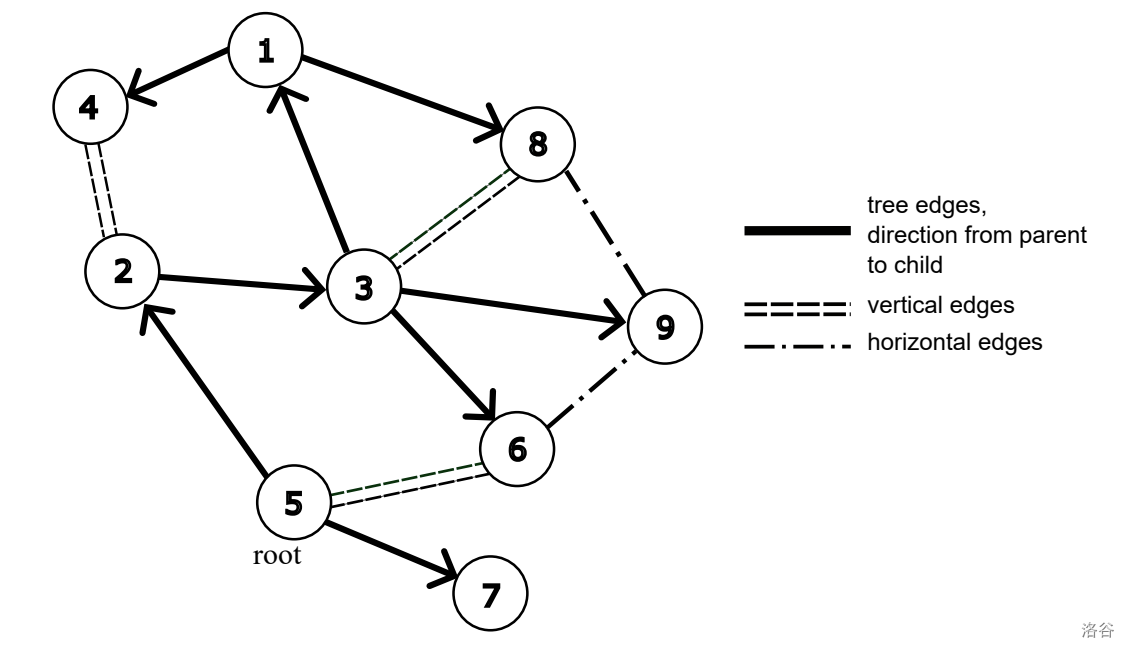 :::
:::
The of the spanning tree in the graph is defined as the number of vertical edges.
You are given a graph with vertices and edges, the root of the tree , and a number , . You need to construct a spanning tree of the given graph with root at , having a verticality equal to , or report that such a tree does not exist.
Input Format
Each test consists of several sets of input data. The first line contains one integer --- the number of sets of input data (). Following this are descriptions of sets of input data.
In the first line of each set of input data, there are four integers , , , and --- the number of vertices and edges in the graph, respectively, the index of the root vertex, and the required verticality of the future spanning tree (; ; ; ).
In each of the following lines, there are two integers , --- the indices of the vertices connected by an edge in the graph (; ).
It is guaranteed that all graphs are connected, contain no loops or multiple edges. It is guaranteed that the sum of across all input data sets does not exceed . It is guaranteed that the sum of across all input data sets does not exceed .
Output Format
For each test case, find the required spanning tree and output in a separate line integers , where is the index of the parent of the -th vertex in the tree (). For , you can output any number from to . If a tree with the desired properties does not exist, output numbers instead.
4
5 7 2 0
1 2
2 3
3 4
4 1
3 5
5 4
1 5
5 7 2 1
1 2
2 3
3 4
4 1
3 5
5 4
1 5
5 7 2 2
1 2
2 3
3 4
4 1
3 5
5 4
1 5
5 7 2 3
1 2
2 3
3 4
4 1
3 5
5 4
1 5
2 1 2 3 3
2 1 4 1 1
2 1 5 5 1
2 1 4 1 3