
#P9792. [NERC 2018] Bimatching

[NERC 2018] Bimatching
Background
Translated from Problem B of NERC 2018.
Problem Description
You are holding a dance party with some friends.
At this party, there are men and women. Originally, the dance is done in male-female pairs, but because there are not enough men, you cannot give every woman a male partner. So you invent a new dance form: one man pairs with two female partners.
Of course, when choosing partners, each woman gives a rating to each man. If the rating is , it means the woman is willing to dance with that man. Only when both women are willing to dance with that man can they form a partner group.
As the organizer, you need to find the maximum number of such partner groups that can be formed, with the requirement that no person can appear in more than one group.
Input Format
The first line contains an integer , the number of test cases.
Then follow test cases. In each test case, the first line contains two integers and . It is guaranteed that and .
Then follows an matrix, where indicates whether woman is willing to dance with man .
Output Format
For each test case, output one line containing the maximum number of partner groups that can be formed.
2
2 3
111
111
3 4
0110
1100
0011
1
2
1
3 6
001100
111111
001100
2
Hint
The Constraints guarantee , , and .
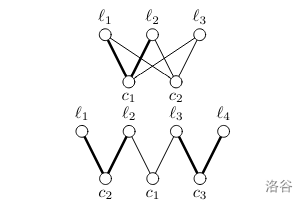
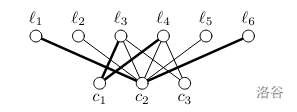
The figures below explain Sample 1 and Sample 2, where the bold parts show one feasible solution.
Sample 1:
Sample 2:
Translated by ChatGPT 5