
#P9434. [NAPC-#1] Stage4 - Needle

[NAPC-#1] Stage4 - Needle
Background
— s10

Problem Description
There are spikes on a plane, with all positions distinct. Each spike has one of directions: up, down, left, or right.
Define a “yin-jian spike” (阴间刺, literally “underworld spike”, actually a shaved sf spike) as an ordered triple of spikes that satisfies:
- faces right, faces left, and faces up.
- .
- .
- .
Here, and denote the -coordinate and -coordinate of spike , respectively. is kid’s width, and it is a constant within one test case.
The positive direction of the -axis is from left to right, and the positive direction of the -axis is from bottom to top.
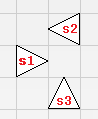
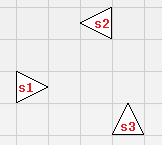
The figures above show two examples of yin-jian spikes when . Although in the second spike shape, does not affect kid’s jump/oh
Given the positions and directions of spikes, tell kid how many yin-jian spikes (that he cannot jump over) there are.
Obviously, downward spikes are meaningless in this problem.
Input Format
This problem contains multiple test cases within a single input file.
The first line contains two positive integers , representing the number of test cases and the testdata id. In particular, for the samples, .
For each test case, the first line contains two positive integers , representing the number of spikes and kid’s width. The next lines each contain two integers and a character , describing the position and direction of one spike: U means up, D means down, L means left, and R means right.
Output Format
For each test case, output one line with one positive integer, the number of yin-jian spikes.
4 0
3 1
2 1 U
1 2 R
2 3 L
3 1
4 1 U
1 2 R
3 4 L
6 4
2 1 U
1 2 R
3 2 U
2 3 L
1 3 R
2 4 L
8 9
4 5 L
1 4 R
3 4 L
2 3 R
1 2 R
3 2 U
4 2 U
3 1 U
1
0
4
6
见附件中的 s4/ex.in
见附件中的 s4/ex.out
Hint
Constraints
This problem uses bundled subtasks.
$$\def\r{\cr\hline} \def\arraystretch{1.5} \begin{array}{c|c|c|c|c} \textbf{Subtask} & id= & {\sum n\leqslant} & \textbf{Other Constraints} & \textbf{Score}\r \textsf1 & 1\sim 7 & 3\times10^4 & n\leqslant 30 & 10 \r \textsf2 & 31\sim45 & 10^4 & - & 25 \r \textsf3 & 8\sim10,16\sim17 & 10^5 & d=10^9 & 20 \r \textsf4 & 18\sim20 & 3\times10^5 & d=1 & 10 \r \textsf5 & 11\sim15,21\sim30 & 3\times10^5 & - & 35 \r \end{array}$$Here, denotes the sum of all within one input file.
For of the data: , , , , , all are distinct, and $c\in\{\texttt U, \texttt D, \texttt L, \texttt R \}$.
Hint
For , both an approach and an approach are worth thinking about. They may both give some hints…? qwq
Sample #1-1 & #1-2 Explanation
See the two figures in the Description.
Note that in #1-2, , so kid can simply squeeze through the gap, and it does not count as yin-jian.
Sample #1-3 Explanation
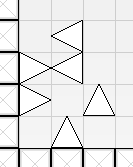
The yin-jian spikes are: $\Big((1,3),(2,4),(2,1)\Big),\Big((1,2),(2,4),(2,1)\Big),\Big((1,2),(2,3),(2,1)\Big),\Big((1,3),(2,4),(3,2)\Big)$, i.e. (the numbers are spike indices: means the -th spike).
Sample #1-4 Explanation
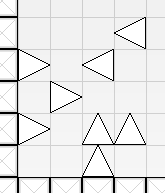
The yin-jian spikes are .
For Sample #2, see the attachment. Besides , this sample satisfies all constraints of .
Translated by ChatGPT 5