
#P9432. [NAPC-#1] rStage5 - Hard Conveyors

[NAPC-#1] rStage5 - Hard Conveyors
Background
Two new groups of hack testdata have been added to this problem.

Harder, so it may be more fragile, so it is easier to break (confirmed).
You only spent two hours to instantly clear the main city s1~s10, and now you are here to instantly clear the reverse city.
Problem Description
The difference between this problem and Stage5 is that the definition of a valid path is different (the bold part in the brief statement is different). (Actually there are also: different samples, different data, different partial scores.)
Brief Statement
You are given an unrooted tree with nodes and key nodes on the tree. Each edge has a weight (i.e. the edge length). There are queries. Each query gives , and asks for the shortest length of a path from to that passes through at least one key node.
Input Format
The first line contains three positive integers , representing the number of nodes in the tree, the number of queries, and the number of key nodes.
The next lines each contain three positive integers , indicating that there is an edge in the tree with weight . It is guaranteed that the input forms a tree.
The next line contains pairwise distinct positive integers, representing the indices of the key nodes.
The next lines each contain two positive integers , representing a query.
Output Format
For each query, output one line with one non-negative integer, representing the shortest length of a valid path for this query.
Note that a valid path may traverse no edges; in this case, the path length is .
7 6 2
1 2 3
1 3 5
3 4 2
3 5 4
2 6 1
1 7 1
2 3
2 3
2 1
7 1
4 5
6 6
2 2
8
3
7
6
2
0
Hint
Constraints
upd at 2023-6-25: Two new groups of hack testdata were added and placed in . They do not count toward the score.
This problem uses bundled tests.
$$\def\r{\cr\hline} \def\None{\text{None}} \def\arraystretch{1.5} \begin{array}{c|c|c|c} \textbf{Subtask} & \text{测试点编号} & \textbf{Sp. Constraints} & \textbf{Score}\r \textsf1&1\sim2 & k=n & 5 \r \textsf2&16\sim20 &k=1,n\leqslant10^3,q\leqslant10^3 & 15 \r \textsf3&21\sim25 & n\leqslant10^3,q\leqslant10^3 & 15 \r \textsf4&3\sim7 & q=1 & 15 \r \textsf5&8\sim15 & - & 50 \r \textsf6&26\sim27 & - & 0 \r \end{array}$$For of the data, , , , , .
Sample Explanation #1
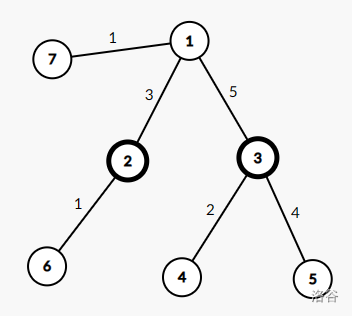
The bold nodes in the figure are key nodes.
For each query, the following is one optimal path (there may be multiple optimal paths):
- .
- .
- .
- .
- .
- (a valid path may traverse no edges; in this case, the path length is ).
Translated by ChatGPT 5