
#P5674. 「SWTR-2」Magical Gates

「SWTR-2」Magical Gates
Background
Little found a treasure map.
Following the route on the map, he arrived at an ancient gate with a hexagram pattern on it.
He gently placed his hand on the hexagram...
In an instant, the hexagram shone brightly, and the surroundings became as bright as day.
(One new large sample has been added.)
Problem Description
In front of Little appeared gates. Each gate has its own index written on it, namely .
At this moment, the gatekeeper Little walked up to Little .
"These gates are not ordinary. They have magic."
"I will give you some intervals . Please find the sum and the product of the magic values of all gates in the interval ."
"Since the result may be very large, output the result ."
"If you answer all queries correctly, you will own all the treasure behind this gate."
"Oh, right. The magic value of a gate is the number of bits in its binary representation."
In short, let the magic value of the -th gate be . Given an interval , compute:
$$\sum_{l}^{r}d_i\bmod\ p \quad \prod_{l}^{r}d_i\bmod\ p$$Because there are far too many gates, Little decided to ask you for help.
Input Format
The first line contains three positive integers ( will be explained in Constraints).
The next lines: on the -th line there are two positive integers .
Output Format
Output lines. Each line contains numbers separated by a space. The -th line should be:
$$\sum_{l}^{r}d_i\bmod\ p \quad \prod_{l}^{r}d_i\bmod\ p$$7 1000000007 0
3 7
1 10
1 1048576
20180815 20180830
20180632 20180639
123456789 987654321
123456789987654321 123456789987654321123456789987654321
10 24
17 96
10485761 64327945
255 803716286
124 290111979
996409842 54001814
253678327 263109263
Hint
Sample Explanation
Testdata 1:
$$\prod_{3}^{7}d_i=2\times 1\times 2\times 2\times 3=24$$Testdata 2:
$$\prod_{1}^{10}d_i=1\times 1\times 2\times 1\times 2\times 2\times 3\times 1\times 2\times 2=96$$Constraints and Notes
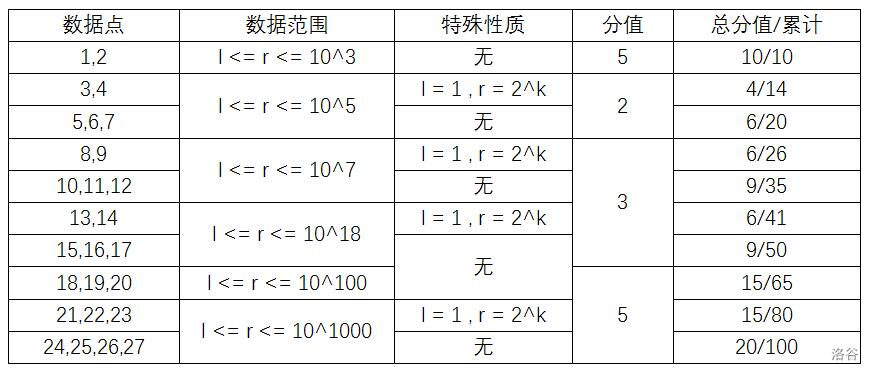
To make it easier to get partial scores, the in the input format is the index of the current test point.
All test points with special properties take up a total of .
For of the data, $1\leq n\leq 27,1\leq T \leq 10,10^9 \leq p \leq 1.001\times 10^9,1\leq l\leq r\leq 10^{1000}$, and is guaranteed to be prime.
For test points , the time limit is , and for the remaining test points the time limit is .
For all test points, the memory limit is .
With a "creak", the dust-covered gate that had been sealed for a thousand years slowly opened.
A dazzling golden light shone out...
Translated by ChatGPT 5